
Injection Molding Automation Solutions for Production
From injection molding robots and custom EOAT grippers to conveyors, inspection, assembly and packaging, KEFAN develops coordinated robotic automation around the molded part, machine cycle and downstream process.
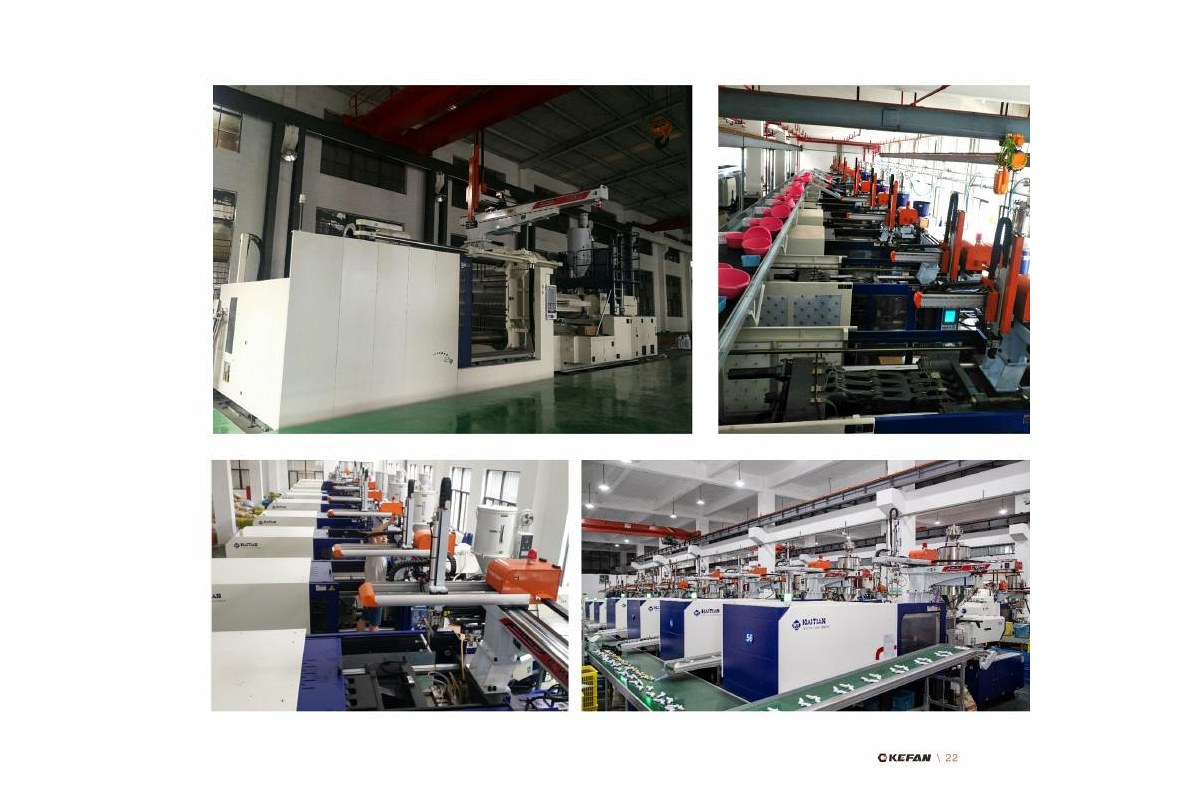
Automation works when every interface works
Reliable robot automation depends on more than the robot alone. EOAT, machine signals, fixtures, sensors, conveyors and safety devices must follow one coordinated sequence.
Robot Selection
Choose top-entry, side-entry, axes, stroke and payload from the real task.
Custom EOAT
Combine vacuum, gripping, insert handling and pickup confirmation.
Peripheral Integration
Connect fixtures, conveyors, inspection, stacking and packaging equipment.
Control & Safety
Coordinate machine signals, sensors, interlocks and safe operating zones.
Build the sequence around your product
Mold
The machine or production process presents the defined task.
Take Out
The robot removes parts, runners or both with confirmed pickup.
Orient
Parts are turned, sorted or positioned for the next operation.
Process
Inspect, trim, assemble, label, stack or perform another task.
Transfer
Send completed products to collection, packing or logistics.
Combine only the functions your cell needs
Start with reliable take-out and add downstream operations where they improve safety, consistency or labor efficiency.
Part & Runner Handling
Remove products and runners, separate release positions and maintain a controlled cycle.
Insert Loading
Pick, orient and place inserts with sensing before removing the finished molded part.
Conveying & Sorting
Transfer products by cavity, orientation, count, inspection result or production batch.
Degating & Trimming
Connect take-out with controlled runner separation or application-specific trimming.
Inspection & Detection
Check presence, orientation or defined quality features before downstream release.
Stacking & Packaging
Arrange parts into layers, counts or packs and connect them to packing operations.
Start with the real production constraint
A useful automation proposal begins with the problem to solve: cycle variation, unsafe handling, labor dependence, product damage, incorrect orientation or a difficult downstream process.
- Injection molding machine and mold information
- Part, runner, insert and EOAT weights
- Required take-out and downstream cycle time
- Part orientation and release locations
- Available floor space and equipment layout
- Quality checks, safety and communication interfaces
Typical System Scope
Standard cell or custom automation?
Complexity should follow the production need, not the number of available features.
Standardized Solution
- Direct take-out and conveyor placement
- Known product orientation and simple EOAT
- Limited downstream coordination
- Faster evaluation with a defined scope
Custom Automation
- Insert loading or multi-function EOAT
- Inspection, trimming, sorting or stacking
- Multiple fixtures or communication interfaces
- Application-specific sequence and layout
Six steps from requirement to production
Requirement Review
Clarify the production objective, machine, mold, product and cycle.
Concept Development
Define robot, EOAT, layout, peripherals and sequence.
Technical Confirmation
Confirm interfaces, safety, product handling and responsibilities.
Build & Integration
Prepare tooling, controls and equipment around the approved concept.
Sequence Testing
Check functions, signals and the complete handling flow.
Delivery & Support
Provide documentation, installation guidance and production support.
Related injection molding automation projects
Explore practical injection molding robot applications, or review the complete robot automation case study library.
Container Handling
Automated pickup, transfer and organized downstream output for molded containers.
Take-Out and Transfer
A robot arm demonstration covering repeatable part removal and downstream handling.
Side-Entry Automation
Rapid mold access and controlled transfer for cycle-sensitive injection molding.
Application engineering around injection molding automation
KEFAN applies industrial automation and robotics engineering to the interfaces between the machine, robot and next production step. That keeps each automation concept practical and tied to the real cycle. Review relevant injection molding robot automation case studies for application examples.
- Robot, EOAT and peripheral planning in one project
- Solutions scaled to actual process complexity
- Clear technical inputs and project communication
- Support from evaluation through production use
Frequently Asked Questions
Can you automate an existing injection molding machine?
Often yes, but mounting space, machine signals, guarding, mold layout and the available work area must be checked.
Do I need a fully custom system?
Not always. Direct take-out and conveying may be enough. Custom equipment is justified when the process requires inserts, orientation, inspection, stacking or other coordinated steps.
Can you integrate equipment from other suppliers?
Interface feasibility can be reviewed from signal, layout, timing and responsibility information.
How is cycle capability confirmed?
It is evaluated from actual travel, payload, EOAT, mold timing and downstream operations. Accurate claims require project data.
What should I send for a quotation?
Send machine and mold data, product drawings, weights, target cycle, required downstream operations and layout constraints.
What should happen after the mold opens?
Share your production sequence and constraints. Our team will help define a practical automation concept.