
5-Axis Servo Robots for Injection Molding
KEFAN 5-axis servo robots for injection molding handle part orientation, complex demolding, insert loading and precise downstream placement. Share your product geometry and required orientation for a suitable configuration and quotation.
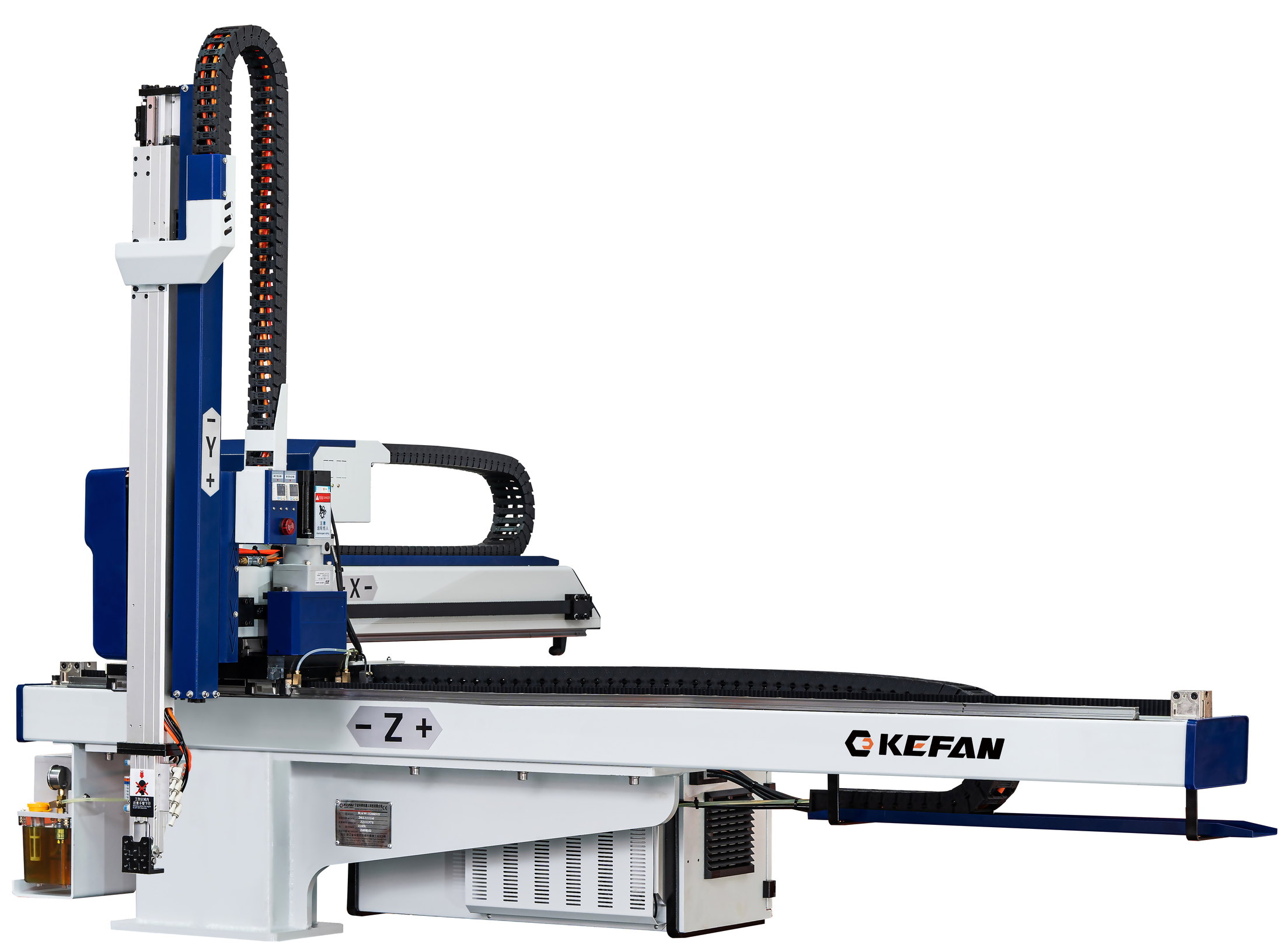
Control position and orientation in one sequence
Beyond basic mold entry and extraction, two additional servo-controlled wrist movements help turn, flip or align parts for precise placement and downstream automation.
Complex Demolding
Additional wrist motion supports products that require controlled rotation or angle changes during removal.
Oriented Placement
Place parts in a defined direction for conveyors, fixtures, inspection or packaging.
Integrated Insert Handling
Coordinate loading and unloading tasks with application-specific EOAT and fixtures.
Programmable Recipes
Store motion sequences for different molds, products and downstream processes.
Five coordinated servo axes
Exact axis naming and travel depend on the selected configuration.
Define the complete motion, not only the machine size
A five-axis robot is selected around the full handling sequence. Our team reviews the molding machine, product, EOAT, wrist orientation and downstream target before recommending a configuration.
- Machine: tonnage, tie-bar spacing, platen height and interface
- Part: size, weight, center of gravity and demolding direction
- Wrist motion: required rotation, flipping and final orientation
- EOAT: gripper weight, vacuum circuits, sensors and inserts
- Process: cycle target, fixture position and downstream operation
Configuration Overview
Verified five-axis servo robot configurations
The following D5 models and core selection data are taken from the current KEFAN robot specification sheet. Main-arm and sub-arm crosswise strokes are listed separately. Final configuration is confirmed against the machine, mold, EOAT and required cycle.
| Model | Suitable IMM | Traverse | Main / Sub Crosswise | Vertical | Maximum Load |
|---|---|---|---|---|---|
| KAI700D5 | 60-160T | 1300 mm | 400 / 400 mm | 700 mm | 5 kg |
| KAI800D5 | 90-200T | 1300 mm | 500 / 500 mm | 800 mm | 5 kg |
| KAW850D5 | 120-260T | 1450 mm | 600 / 600 mm | 850 mm | 6 kg |
| KAW950D5 | 180-300T | 1450 mm | 700 / 700 mm | 950 mm | 7 kg |
| KAW1100D5 | 260-400T | 1850 mm | 850 / 850 mm | 1100 mm | 8 kg |
Specification reference data. Specifications and availability are reconfirmed for each quotation.
Designed for more demanding handling sequences
Use the additional wrist freedom where part angle, orientation or coordinated post-mold handling matters.
Deep-Cavity Parts
Use controlled movement and orientation where straight-line removal is not sufficient.
Insert Molding
Load inserts and remove finished parts with a multi-function EOAT and planned sequence.
Fixture Placement
Align parts to a fixture for trimming, assembly, inspection or other secondary operations.
Oriented Conveying
Turn products before placement so downstream equipment receives a consistent orientation.
Stacking & Sorting
Arrange parts by orientation, layer or production batch for efficient collection.
Automated Cells
Coordinate molding, EOAT, fixtures, inspection and packaging as one production system.
When does a five-axis robot make sense?
The best choice depends on the required handling sequence rather than simply choosing more axes.
Choose 3 Axis When
- The part can be removed with direct linear motion
- Release orientation does not need to change
- The task is straightforward take-out and placement
- A simpler automation sequence meets the process
Choose 5 Axis When
- The part must rotate or flip during handling
- Insert loading and unloading share one cycle
- Precise orientation is required at the release point
- Fixtures or secondary processes need coordinated positioning
Engineering support from concept to production
Robot motion, EOAT and cell interfaces are reviewed together to keep the proposed solution practical.
Share Requirements
Send machine data, product details, drawings, orientation needs and target cycle.
Confirm the Sequence
We review reach, payload, wrist motion, EOAT, interfaces and downstream positions.
Build & Test
The selected configuration and tooling are prepared and the handling sequence is checked.
Install & Support
We provide operating guidance and technical support for commissioning and production.
One team for robot, EOAT and integration
Five-axis automation depends on correct coordination between motion, wrist orientation and tooling. KEFAN supports the application as a complete system. For direct take-out without wrist reorientation, compare our 3-axis servo robots, or review custom EOAT grippers for product handling.
- Robot selection based on the actual working envelope
- Custom EOAT for gripping, vacuum, inserts and detection
- Integration support for fixtures and peripheral equipment
- Clear technical communication through project delivery
Frequently Asked Questions
What are the extra two axes used for?
They provide additional wrist rotation and flipping/orientation movements. The exact mechanism and travel depend on the selected robot configuration.
Do I need five axes for every injection molding application?
No. A three-axis robot is often sufficient for direct take-out and placement. Five axes are useful when the product must rotate, flip, align to a fixture or complete a more complex handling sequence.
Can the robot handle inserts?
Yes, where the product and mold process allow it. EOAT, insert fixtures, sensing and the complete sequence must be reviewed for the application.
What information is needed for selection?
Please send machine tonnage and dimensions, product weight and drawings, mold details, EOAT requirements, required wrist orientation and target cycle time.
Can it connect with downstream equipment?
Yes. Fixtures, conveyors, inspection, trimming, stacking and packaging equipment can be considered in the automation plan.
Does your part need more than simple take-out?
Share the molding machine, product, required orientation and target cycle. Our team will recommend a practical five-axis configuration.